
Integración API personalizada
Conecta tu chatbot con IA a cualquier API externa. Obtén datos, crea registros, activa webhooks: intégralo con tus sistemas personalizados.
¿Qué es la integración de API personalizada?
La integración API personalizada permite que tu chatbot con IA se conecte a cualquier API REST o webhook. Puedes obtener datos en tiempo real, como los niveles de inventario, crear registros en cualquier sistema, activar automatizaciones, enviar notificaciones o integrarse con sistemas empresariales propios.
La configuración básica se puede realizar a través de nuestra interfaz visual, configurando los puntos finales y los parámetros. Para integraciones más complejas que impliquen la transformación de datos o lógica condicional, puede ser útil contar con algunos conocimientos técnicos.
Capacidades de la API
Solicitudes GET
Obtener el estado del pedido, la información de la cuenta, los niveles de inventario y los precios.
Solicitudes POST
Cree tickets, clientes potenciales, pedidos, envíos... cualquier registro.
Webhooks
Activa flujos de trabajo en Zapier, Make, n8n o tu backend.
Autenticación
Claves API, OAuth, tokens de portador, encabezados personalizados.
Mapeo de respuestas
Analizar respuestas JSON y utilizar los datos en los mensajes del bot.
Gestión de errores
Recursos elegantes cuando las API fallan o se agota el tiempo de espera.
Véalo en acción
In this example, the chatbot calls a weather API to look up current conditions when a visitor asks “What’s the weather in Denver?”

Configuración paso a paso
Go to AI Chatbot Settings → AI Actions and click Add Action. Configure the fields below to connect your API.
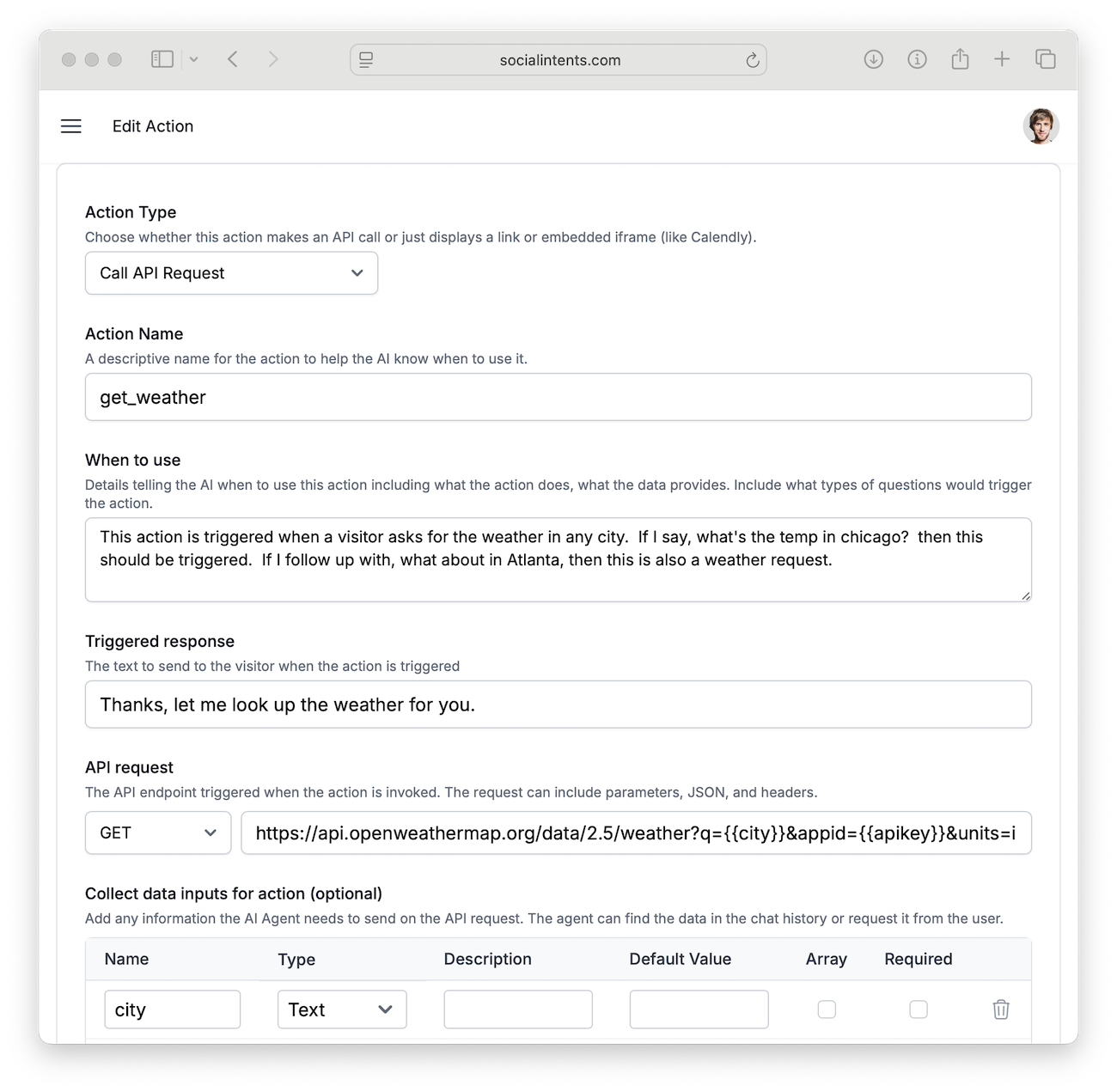
| Field | Description | Example |
|---|---|---|
| Action Type | Choose Call API Request to make an HTTP call when the action fires. |
Call API Request |
| Action Name | A unique function name. Use snake_case. | obtener_tiempo |
| When to use | Natural-language description of when the AI should call this API. | When the user asks about current weather conditions |
| Collect data inputs | Data to gather before calling the API. These become {{variable}} placeholders in the URL. |
city, apiKey |
| API URL | The endpoint to call. Use {{variable}} template syntax to inject collected data. |
https://api.openweathermap.org/data/2.5/weather?q={{city}}&appid={{apiKey}} |
| HTTP Method | GET for retrieving data, POST for sending data. | GET |
| Headers | Optional HTTP headers (e.g., Authorization). One per line in Key: Value format. |
Authorization: Bearer sk-xxx |
Example Use Cases
Consulta meteorológica
Let visitors ask “What’s the weather in Denver?” and get a live answer.
GET https://api.openweathermap.org/data/2.5/weather
    ?q={{city}}&appid={{apiKey}}&units=imperial
Order Status
Visitors provide an order number, the chatbot calls your order API and returns the status.
GET https://api.yourstore.com/v1/orders/{{orderId}}/status
Headers:
  Authorization: Bearer {{apiToken}}