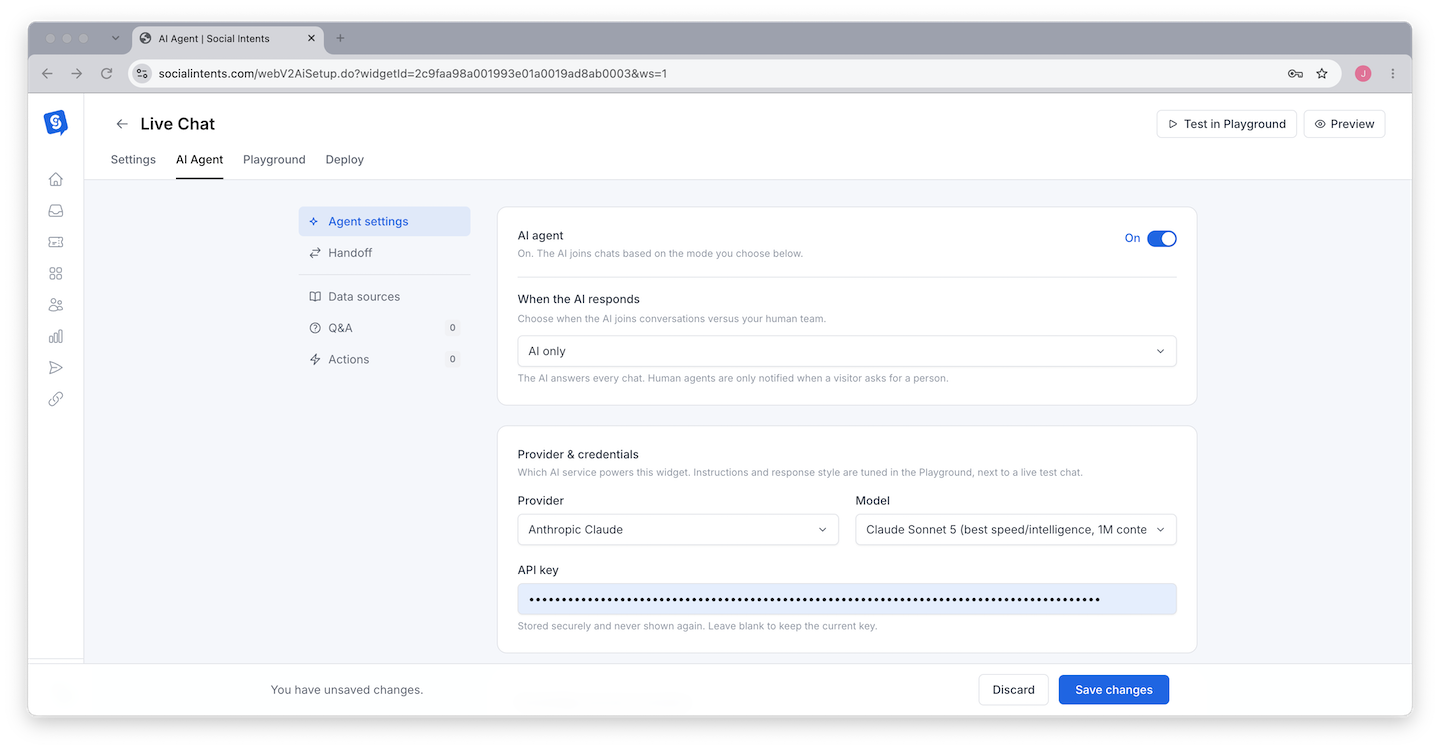
Social Intents supports three major AI engines for powering your chatbot: ChatGPT (OpenAI), Claude (Anthropic), and Gemini (Google). Each engine has different strengths, response styles, and pricing models. This guide compares all three engines across every dimension that matters - accuracy, conversation quality, instruction following, pricing, and ideal use cases - so you can make an informed decision for your chatbot.
Supported AI Engines Overview
When you configure a chatbot in Social Intents, the Chatbot Type dropdown offers three AI engines - all powered by modern large language models (LLMs):
| Engine | Provider | Type | Default Model |
|---|---|---|---|
| ChatGPT | OpenAI | Large Language Model | gpt-4o (free) or gpt-5.2 (BYOK) |
| Claude | Anthropic | Large Language Model | Claude Sonnet 4.5 (BYOK) |
| Géminis | Large Language Model | Gemini 2.5 Flash (BYOK) |
ChatGPT (OpenAI)
Visión general
ChatGPT is the most widely used AI engine in the world. Powered by OpenAI, it offers strong general-purpose conversational abilities and has the largest ecosystem of documentation, examples, and community support. Social Intents includes two free OpenAI models with every subscription and supports many more via Bring Your Own Key (BYOK).
Available Models
Free with your Social Intents subscription (no API key required):
| Model | Characteristics | Ideal para |
|---|---|---|
| GPT-3.5 Turbo | Fast and lightweight. Good for straightforward questions. | Simple FAQ bots, high-volume use |
| GPT-4o | Fast, affordable, multimodal capable. Strong balance of quality and speed. | General customer support, most use cases |
BYOK models (requires your own OpenAI API key):
| Model | Characteristics | Ideal para |
|---|---|---|
| gpt-4o-mini | Compact version of GPT-4o. Lower cost with solid quality. | Cost-conscious deployments |
| gpt-4-turbo | High-quality reasoning with larger context window. | Complex technical support, long conversations |
| gpt-4 | Original GPT-4. Strong reasoning, moderate speed. | Detailed analysis and explanations |
| gpt-4.1 | Next-generation GPT-4 with improved instruction following. | Precise, instruction-heavy chatbots |
| gpt-4.1-mini | Compact version of GPT-4.1. Good balance of cost and capability. | Budget-friendly with modern capabilities |
| gpt-4.1-nano | Ultra-lightweight GPT-4.1 variant. Fastest and cheapest BYOK option. | Maximum throughput, minimal cost |
| gpt-5.2 | Best for coding and agentic tasks. 400K context window. OpenAI's most capable model. | Advanced use cases, complex reasoning |
| gpt-5-mini | Compact GPT-5 variant. Strong reasoning at reduced cost. | Advanced support at moderate cost |
| gpt-5-nano | Lightweight GPT-5 variant. Fast and affordable. | High-volume advanced chatbots |
Select the model from the Model dropdown in your widget's AI Chatbot Settings tab. The free models (GPT-3.5 Turbo and GPT-4o) are available to all subscribers without an API key. BYOK models require an OpenAI API key.
Strengths
- Versatile conversational flow - ChatGPT handles many topics naturally and maintains context well across multi-turn conversations
- Widely understood - Most online resources, guides, and prompt engineering techniques are written for ChatGPT first
- Free models included - GPT-3.5 Turbo and GPT-4o are included free with every Social Intents subscription - no API key needed
- Strong coding and technical support - Excels at explaining technical concepts and guiding users through processes
- Extensive model selection - 11 models ranging from GPT-3.5 Turbo to GPT-5.2 let you balance cost vs quality for your specific needs
Limitations
- Can occasionally hallucinate (generate plausible but incorrect information) when training data is thin
- OpenAI pricing can fluctuate as they release new models
- Some countries have restricted access to OpenAI APIs
Getting an API Key
Visit platform.openai.com/api-keys to create an API key. You need an OpenAI account with billing enabled. New accounts receive free credits to get started.
Claude (Antrópico)
Visión general
Claude is built by Anthropic with a focus on safety, helpfulness, and instruction-following. Claude is known for being particularly good at following complex, multi-part instructions precisely - making it well-suited for chatbots that need to adhere to strict company policies, compliance requirements, or nuanced response guidelines.
Available Models
| Model | Characteristics | Ideal para |
|---|---|---|
| Claude Sonnet 4.5 | Anthropic's latest and most capable model. Excellent reasoning and instruction following. | General customer support, most use cases |
| Claude Haiku 4.5 | Fast and affordable latest-generation model. Concise, efficient responses. | High-volume, cost-sensitive deployments |
| Claude Opus 4.5 | Highest quality reasoning. Slower and more expensive. Maximum capability. | Complex analysis, detailed explanations |
| Claude 3.7 Sonnet | Previous-generation Sonnet with extended thinking. Strong analytical reasoning. | Nuanced support requiring deep analysis |
| Claude 3.5 Haiku | Fast, affordable previous-generation model. | Budget-friendly quick-response bots |
| Claude 3.5 Sonnet v2 | Updated 3.5 Sonnet with improved performance. | Reliable general-purpose chatbots |
| Claude 3.5 Sonnet v1 | Original 3.5 Sonnet. Well-tested and stable. | Production chatbots wanting proven models |
| Claude 3 Opus | Legacy top-tier model. Thorough, careful responses. | Complex multi-step analysis |
| Claude 3 Sonnet | Legacy mid-tier model. Balanced quality and speed. | General-purpose use at lower cost |
| Claude 3 Haiku | Legacy fast model. Minimal cost per message. | Simple FAQ, maximum volume |
Strengths
- Excellent instruction adherence - Claude follows complex system instructions more reliably than most other models. If you define boundaries, Claude respects them.
- Nuanced, thoughtful responses - Claude tends to give more considered, balanced answers rather than quick surface-level responses
- Strong safety alignment - Built with Constitutional AI principles, Claude is less likely to generate harmful, biased, or inappropriate content
- Long context handling - Claude handles long conversations and extensive training content well, maintaining coherence throughout
- Compliance-friendly - Particularly suitable for regulated industries like healthcare, finance, and legal where response accuracy and boundary-adherence matter
Limitations
- Can be more verbose in responses compared to ChatGPT
- Anthropic's ecosystem and community are newer and smaller than OpenAI's
- Requires your own Anthropic API key (BYOK) - no free tier included with Social Intents
Getting an API Key
Visit console.anthropic.com to create an API key. Create an Anthropic account and navigate to the API Keys section. New accounts may receive trial credits.
Géminis (Google)
Visión general
Gemini is Google's AI model, designed with strong capabilities in structured data handling, multimodal understanding, and integration with the Google ecosystem. Gemini is a good choice if your team already uses Google Workspace or if your chatbot needs to handle data-heavy or structured queries.
Available Models
| Model | Characteristics | Ideal para |
|---|---|---|
| Gemini 2.5 Flash | Fast, cost-efficient model with strong general performance. Good default choice. | General customer support, most use cases |
| Gemini 2.5 Flash-Lite | Ultra-lightweight variant of 2.5 Flash. Lowest cost per message. | High-volume, cost-sensitive deployments |
| Gemini 2.5 Pro | Google's most capable model. Best reasoning and accuracy. | Complex queries, detailed explanations |
| Gemini 2.0 Flash | Previous-generation fast model. Reliable and well-tested. | Production chatbots wanting proven stability |
| Gemini 3 Pro (Preview) | Next-generation pro model. Advanced capabilities in preview. | Early adopters wanting cutting-edge features |
| Gemini 3 Flash (Preview) | Next-generation flash model. Fast performance in preview. | Testing next-gen capabilities at lower cost |
Strengths
- Multimodal capabilities - Gemini is built from the ground up to handle text, code, and structured data
- Google ecosystem integration - Natural fit for teams using Google Workspace, Google Cloud, and other Google services
- Structured data handling - Excels at understanding and responding to queries about structured information, tables, and data
- Competitive pricing - Google offers competitive API pricing with a generous free tier through Google AI Studio
- Global availability - Available in regions where other providers may have restrictions
Limitations
- Newer to the market compared to ChatGPT and Claude, with a smaller support community
- Requires your own Google API key (BYOK) - no free tier included with Social Intents
- Response style can sometimes be more formal compared to ChatGPT
Getting an API Key
Visit Google AI Studio to create a Gemini API key. You need a Google account. The free tier includes a generous monthly quota.
Head-to-Head Comparison
Here is a side-by-side comparison across the dimensions that matter most for a customer-facing chatbot:
| Dimension | ChatGPT | Claude | Géminis |
|---|---|---|---|
| Conversational Quality | Excellent - natural and fluid | Excellent - thoughtful and precise | Good - can be more formal |
| Instruction Following | Good | Excellent - best in class | Good |
| Response Speed | Fast (GPT-4o) | Fast (Sonnet 4.5) | Fast (2.5 Flash) |
| Hallucination Risk | Moderate | Low to moderate | Moderate |
| Model Selection | 11 models (2 free + 9 BYOK) | 10 models (BYOK) | 6 models (BYOK) |
| Setup Complexity | Simple | Simple | Simple |
| Community & Resources | Largest | Growing | Growing |
| Safety / Compliance | Good | Excellent | Good |
| Precios | 2 models free, BYOK moderate | BYOK moderate | BYOK competitive |
Choosing the Right Engine for Your Use Case
General Customer Support
Recommended: ChatGPT (GPT-4o, free) - Handles the widest range of customer questions naturally and is included free with your subscription. Most prompt engineering resources are written for ChatGPT, making it easier to optimize. Start here if you are not sure.
Regulated Industries (Healthcare, Finance, Legal)
Recommended: Claude (Sonnet 4.5) - Claude's strength in following complex instructions precisely makes it ideal when your chatbot must stay within strict guidelines. It is less likely to drift outside its boundaries or generate content that could create compliance issues.
Technical and Developer Support
Recommended: ChatGPT (GPT-4o free, or gpt-5.2 / gpt-4.1 BYOK) - ChatGPT excels at technical explanations, code examples, and step-by-step troubleshooting. GPT-4o is free and handles most technical topics well. For advanced reasoning, gpt-5.2 and gpt-4.1 (BYOK) offer the strongest performance.
High-Volume, Cost-Sensitive Deployments
Recommended: ChatGPT (GPT-3.5 Turbo, free) or gpt-4.1-nano (BYOK) - GPT-3.5 Turbo is included free with your subscription and handles simple FAQ queries well. For BYOK users wanting the cheapest per-token option, gpt-4.1-nano and Gemini 2.5 Flash-Lite offer the lowest costs.
Data-Heavy and Structured Queries
Recommended: Gemini - If your chatbot deals with product catalogs, pricing tables, specifications, or other structured data, Gemini's design for structured data handling gives it an advantage.
Google-Centric Workflows
Recommended: Gemini - If your team lives in Google Workspace and you want alignment with Google's AI ecosystem, Gemini is the natural choice.
Switching Engines
Social Intents makes it easy to switch engines. In your widget's AI Chatbot Settings tab, simply change the Chatbot Type dropdown and enter an API key for the new engine. Your other settings are preserved:
- System instructions carry over
- Escalation phrases and confirmation messages remain
- Welcome messages and quick replies stay the same
Using Multiple Engines Across Widgets
Each widget has its own independent chatbot configuration. You can use different AI engines on different widgets. This is useful for:
- A/B testing engines - Set up two widgets with different engines and compare response quality and customer satisfaction
- Different departments - Use Claude for your compliance-sensitive support widget and ChatGPT for your general sales widget
- Cost optimization - Use a premium model on high-value pages and a cheaper model on general FAQ pages
Preguntas frecuentes
Which engine is cheapest?
Social Intents includes GPT-3.5 Turbo and GPT-4o free with every subscription - no API key needed. For BYOK usage, gpt-4.1-nano (OpenAI) and Gemini 2.5 Flash-Lite (Google) are among the cheapest per-token options. Pricing varies by provider and changes over time - check each provider's pricing page for current rates.
Can I use my own fine-tuned model?
Social Intents uses the model name you enter in the Model field. If your OpenAI account has a fine-tuned model, you can enter its model ID in the field and it will be used for your chatbot responses.
Which engine has the lowest hallucination risk?
Claude is generally regarded as having the lowest hallucination risk due to its Constitutional AI training methodology. However, all LLMs can hallucinate. The most effective way to reduce hallucinations is to provide thorough training content and clear system instructions, regardless of which engine you use.
Do all engines support streaming responses?
Yes. Social Intents supports streaming responses for all three LLM engines. Streaming means the response appears to the visitor word-by-word in real time, rather than all at once after processing is complete. This gives visitors a faster perceived response time.
What if one engine is down or experiencing outages?
If your AI provider's API is not responding, the chatbot will not be able to generate responses. The chat will fall back to your configured offline behavior or human agent routing. To ensure continuity, consider having a backup widget configured with a different engine.
Which engine is best for non-English languages?
All three engines support multiple languages. ChatGPT and Claude have strong multilingual capabilities. Gemini also supports many languages. For best results in non-English languages, write your system instructions in the target language and train your chatbot on content in that language.
How do I know if my engine choice is working well?
Monitor your chatbot conversations regularly. Look at the chat transcripts to see how the engine responds to real visitor questions. Pay attention to accuracy (is it answering correctly?), tone (does it sound right for your brand?), and completeness (does it give enough information?). If you notice patterns of weak responses, try switching engines or adjusting your system instructions before concluding the engine itself is the problem.
Can I test different engines before committing?
Yes. Since each provider offers free credits or free tiers for new accounts, you can test all three engines at no cost. Create separate widgets or change the engine on a single widget to compare responses to the same questions. Most users can evaluate all three engines within a day of testing.
Cost Management Tips
Regardless of which engine you choose, there are several ways to manage and optimize your AI costs:
- Set appropriate max tokens - Limiting the response length reduces per-message cost. For simple FAQ-style answers, 200-300 tokens is usually sufficient. For detailed explanations, 500-800 tokens works well.
- Use the right model tier - Start with the free GPT-4o model. Only upgrade to BYOK models like gpt-5.2 or gpt-4.1 if you need advanced reasoning capabilities.
- Use offline-only mode - If you have human agents during business hours, set the chatbot to respond only when offline. This cuts AI costs to after-hours usage only.
- Write precise system instructions - Clear instructions lead to focused responses that consume fewer tokens. Vague instructions lead to longer, more meandering responses that cost more.
- Train on focused content - The more relevant your training content, the fewer tokens the AI needs to retrieve and process to generate a good answer.
- Monitor your provider dashboard - All three providers offer usage dashboards where you can track daily and monthly costs. Set up billing alerts to avoid unexpected charges.
Engine Selection Decision Tree
Use this quick decision guide to select your engine:
- Is compliance or strict boundary adherence your top priority? → Choose Claude
- Are you on a tight budget or need maximum free usage? → Use the free GPT-3.5 Turbo or GPT-4o included with your Social Intents subscription
- Do you need the widest community support and resources? → Choose ChatGPT
- Is your use case data-heavy or structured? → Choose Gemini
- Are you building a general-purpose support chatbot? → Choose ChatGPT GPT-4o (free with subscription)
- Not sure? → Start with ChatGPT GPT-4o. It is free, versatile, and you can always switch later.